Monday, 9 May 2016
(very) mini documentary on the early family life of the Coots
I know I should probably be revising instead, but have taken the evening off to put a short video together about the new coot families arriving at the lake, whilst unveiling a nasty secret about their family lives...

Saturday, 30 April 2016
Spring is here! (apparently)
The snow has been falling, the wind blowing, and the rain
pouring down onto Nottingham - of course this can only mean its spring. It has
been a while since I took a visit to the university lake, and despite the
recent strange weather, it is like somebody has waved a wand over the lake,
transforming it while I have been home for Easter. The black headed gulls that
were so numerous have vanished and taken with them the grey and drab cloth that
swamped us over winter. In every corner of the lake a nest has risen out of the
water to host a coot family that is soon to arrive. Some new arrivals on the
lake who looked like something crafted by the devil himself, and a slightly
older friend from last term I was a delight to meet again too. Everything is
happening on the lake, and I can’t wait to see what may happen next!
While I felt quite privileged being able to watch this one nest so close, it was not long before I realised coot nests had popped up all over the lake. All along both sides of the lake the water is quite shallow, meaning nine nests in total were made all along the banks of the lake. There was one nest amongst the willow tree branches where the twigs could easily be bundled together, held by the long fingers of the willow branches like a leafed cage around the home. Another had been dumped in a slightly unexpected place, amongst the scurvy and scummy remnants of rubbish, twigs and slime. The gentle currents in the lake pushed surface debris to this south corner of the lake, perhaps making it easy to gather nearby items quickly, before it would be broken down by the slow running water.
While I was happy to see the new arrivals, my heart leapt
when I found a slightly older friend who I had met last term. I was concerned
after walking most of the way around the lake and catching no sign of the
Egyptian Goose family. My worries were set aside however, when then there he
was, barely recognisable, a gangly and strange looking teenage chick, bumbling
around on the boat ramp. The father was nowhere to be seen, as Billy (which I
have now named him) is old enough to only need the care of one parent. The
transformation that can happen in the space of a month is still hard to
believe. The look of strength in his legs now was phenomenal, fully grown and
just waiting for his adolescent body to catch up. His body was now half the size of an adult, and his proper juvenile feathers had come through. It was
magical to see him from the fluffy little ball I had first met curled up in the
sun. Through frosts, and wind, and snow, rain and sleet, this little chick had
grown up so much and it was a wonderful thing to see.
On first arrival, I caught a glimpse of my first nesting
Eurasian Coot. There she sat, very satisfied with her arrangement of sticks and
leaves piled up high in the water. The lady of the house had to constantly
maintain her mound in this shallower part of the lake to avoid her home being
swept beneath her with the gentle currents. As usual, I was transfixed by her
forthrightness as she was plumping all her leaf cushions, shaking them and
patting them down on her bed ready for her babies to arrive. I wasn’t too sure
what difference this made as the bed didn’t seemed to change all too much from
before she had started organising her nest, but I got the feeling this was a
very important task that needed to be attended to.
 |
| the Eurasian Coot, very proud of her nest in the scummy corner of the lake |
While I felt quite privileged being able to watch this one nest so close, it was not long before I realised coot nests had popped up all over the lake. All along both sides of the lake the water is quite shallow, meaning nine nests in total were made all along the banks of the lake. There was one nest amongst the willow tree branches where the twigs could easily be bundled together, held by the long fingers of the willow branches like a leafed cage around the home. Another had been dumped in a slightly unexpected place, amongst the scurvy and scummy remnants of rubbish, twigs and slime. The gentle currents in the lake pushed surface debris to this south corner of the lake, perhaps making it easy to gather nearby items quickly, before it would be broken down by the slow running water.
 |
| The nest tucked into the bank of the lake, and the Coot pruning her feathers in the rain |
 |
| believe it or not a family live here! |
In contrary to my initial thoughts, it soon became apparent
that the coots had no good sense of housekeeping at all in their nest building.
While they did spend a substantial amount of time ensuring the nest remained
sturdy and intact, this is the point that I stopped agreeing with their
requirements of a good home. I came across yet another nest in the lake in one
of the grimiest locations they could have chosen. Between some black railings
and a few willow branches that had rooted amongst a pile of stagnant rubbish
settled my best find of the day. Out from behind the rubbish, emerged three ugly
and wrinkly individuals, with heads red like fire with tufts of burnt off
feathers, sprouting out these strange evil looking minions’ necks. I laughed to
myself as the coot parents doted upon these horrible children, a parent’s love
really is blind.
 |
| the ugly little chick next to an unhatched egg |
 |
| mother and chick, or now teenager |
 |
| Billy looking very gangly - still has a lot of growing to do! |
Monday, 14 March 2016
A well earn't break and a trip to the University lake
Today the sun was shining, and
having spent the last few weeks shut away, slaving over a dissertation, I
decided it fit to take a stroll to see what the university lake had on offer. I
was thrilled with what I saw. The first of the chicks for this year was
pottering around the shallows, the lesser black-headed gulls were dancing like
fighter planes in the wind, and the swans seemed like they had mastered the
technique in gaining every ounce of respect from their peers – well most of
them had it sussed anyway.
Last week I had been lucky enough
to see four Egyptian Goose chicks scuttling around the lake as I was
undertaking a practical with the university catching invertebrates. I
had not thought to bring my camera, but came back a few days ago to see how
they were getting on. I was disheartened to find that only one chick
remained from this clutch, and so came back today, willing him to still be
alive, having survived the harsh frosts of last week. It comes to no
surprise that these doting parents have been struggling to support their
children when there is still frost on the ground, and a biting wind in the air. However, after being assured by the the chick's mother and father that the he would be
looked after with all the care they could provide, I carried on my jaunt
to see mass of gulls at the end of the lake, as something was drawing a
crowd.
 |
| Checking that I am not up to mischief and am staying a good distance from her chick |
 |
| the chick sleeping in the sun, with dad grooming his feathers |
 |
| The Egyptian Goose chick (ironically not actually classified as a goose) |
On arriving at the madness of
diving, and squawking, and swooping and squeaking, I soon realised what the
fuss was about. An older man was providing quite a feast, and each time the little man threw some food out of his trolley, it attracted a swarm of locust like gulls that would dive down to crash land on the grass
for a meal. Each bomber would waste no time in redeeming their dignity
from the fall, and instead would snatch a snack, or begin
to scream to their neighbour to hand over the winnings without a moments hesitation. I laughed when one wave would cease for a moment and the gulls
would sore back into the sky, to leave the shell-shocked
mallards below. The ducks had a completely different
tactic to eating their dinner, as they plodded along through the grass, continuously wiggling their
bottoms side to side, in hope of picking up something that the all too frantic
gulls may have missed. Once the man left with his food, the fun was over far
too quickly, and I left the ducks to rummage through the crumbs to pay the
swans a visit.
 |
| the man with his bag of food |
 |
| the black headed gulls diving for food |
 |
| the gulls flying off after their feast |
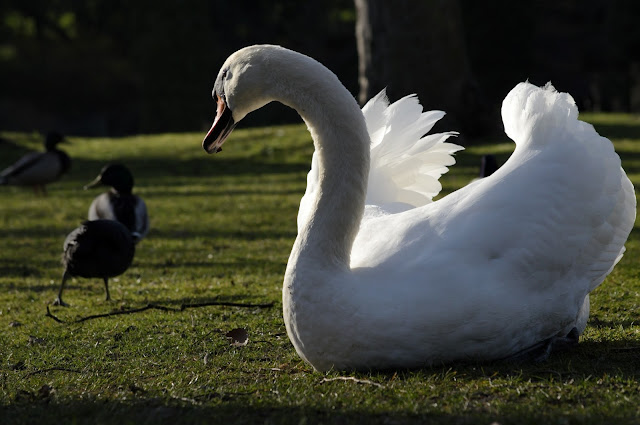 |
| The swan seems to have his eye on a Coot who dared to come near |
 |
| One of my most regal shots of a swan |
 |
| The juvenile trying to state his territory, I kept my distance |
 |
| The juvenile again, showing his size |
 |
| The youngster appearing to have given up a little here |
 |
| not so relevant to my story, but I had to upload this picture of a moorhen who was crowching around the side of the lake |
Saturday, 27 February 2016
The Nightjar project, from the summer of 2015
As a third year student at The
University of Nottingham, I have been studying the impact of human disturbance
on the breeding of the European nightjar (Caprimulgus
europaeus). In the summer of 2015 we surveyed the recreational trail usage
in the forest, the wildlife abundance, and breeding success of the nightjar.
The surveying of the trails was carried out by myself and a masters student
Jack Rayner under the supervision of Dr. Kate Durrant, while the monitoring of
nightjar breeding was led by the Birklands Ringing Group.
 |
| A little friend we met on one of our surveys |
 |
| One of the many bees that were pollinating the heather in the forest |
 |
| A moth we came across quite frequently, not sure which species though? (Please comment if you know!) |
 |
| A mother nightjar, who is rather insulted at being disturbed from her afternoon nap |
 |
| The same mother nighjtar, whatching us with a glaring eye |
Historically, nightjar have been
shown to be less successful in breeding where human disturbance is greater. In
recent years however, we may have found that the nightjar in this forest may
have become more habituated to human disturbance, impacting the consideration
of the suitability of nightjar habitat in the future.
 |
| A buzzard in the early morning, keeping a careful eye on us at work. |
 |
| After seeing that Jack and I were carrying out the surveying well, the buzzard left us for more important duties for the day |
To Find out more, please take a visit on the Sherwood Pines website! http://www.sherwood-nightjars.com/the-project
Thursday, 25 February 2016
The Crafty Cormorant
Last week I took a visit to the university lake where I met
a Great Cormorant. His face looked like the cross between that of a dinosaur
and a gnarly troll. Given that previous description, it seems impossible for me
to like this bird, but given his crafty and wily nature, his phenomenal
resilience, and incredible hunting skills I could not help but enjoy the
company of this prehistoric animal.
I first caught sight of the cormorant at the side of a lake,
basking with his wings welcoming the sun. It is easy not to wonder why the
cormorant undertakes the task of drying his wings, but I could not help but think
this myself. As his looks would suggest, the Great grey Cormorant is one of the
most prehistoric species, along with the Shags. Unlike the more recently
evolved water bird species, the cormorants have not evolved a waxy coating on
their feathers, and so understandably will get rather wet after a hunt for his
fish or whatever meal is available. After becoming sodden from a hopefully successful
attempt to catch dinner, the cormorant will stand on a perch for an hour if
needed to dry off any water that may not be shaken off. While this
characteristic is reasonably interesting, the wing drying behavioural quirk
provided scientists with the ability to carry out an experiment revealing something
rather more intriguing.
 |
| One of the Coromorant standing minding his own business |
 |
| A cormorant looking back very disapprovingly at me after folding back his wings, and ceasing to dry his feathers |
Recent research has been
undertaken to study the migration behaviours of Roach fish. Through use of the
cormorant feeding behaviour, evidence has been gathered to demonstrate the
reasoning behind migrations. Once a cormorant has caught a fish, he will
regurgitate spit balls at the perch on which he is drying his feathers on. If a
fish has been pit tagged (a form of microchip-like identification), all morphometric measurements can be taken of that
fish, and so we can understand what size fishes are being eaten by
the cormorant. It was found that fish spending more time outside a lake would
be less likely to be eaten by the cormorants, but will also be less likely to
find plentiful food. In addition to this, it was found that the bigger fish
were more likely to get caught. Using this information, and the information of
when the fish left the lake to migrate, they found that when the risk of being
predated outweighed the food benefit provided by a lake over another stream,
the fish would leave the lake. Bigger fish were more likely to leave the lake,
and especially so when predation pressures were high and less food was
available in the lake.
While the cormorant is currently
causing great concerns with regards to impact on current biodiversity, given
past distributions I cannot help but admire the resilience of this species. Historically,
cormorants were regarded as an irritating competitor for fish by fishermen, and
so were nearly hunted to extinction. Since, the Great Cormorant has escalated
in numbers to the 1.2 million individuals in Europe today. The Great Cormorant is
now thriving in the UK, and now the species is predicted to cause incredible
changes in our aquatic and terrestrial ecosystems. There are great concerns over
the impacts that cormorants may have on ecosystems, with relocation of matter and
microbial agents between ecosystems, and the possible food web modifications
that may follow the cormorant’s population growth. It is true that in the
future we may need to control cormorant populations, however it is still
fantastic to see such a prehistoric creature on our doorstep, and I thoroughly
enjoyed admiring the bird in the sun all the same.
 |
This isn't much to do with the blog, however I did think the gulls looked
brilliant sitting in a line along the concrete posts |
Saturday, 20 February 2016
Wollaton's Wacky Wildlife
So I have been rather quiet over the last few weeks, putting
together a video from the last few months of footage I have gathered from
Nottingham. I had so much fun making it, and I hope you have as much fun
watching it with the few surprises I have edited in (not your normal wildlife
video I promise you!)
Thanks a lot, and thank you to Fat Freddy's Drop for the music,
and to the wonderful wildlife who helped create it!
Sunday, 7 February 2016
A trip to Brighton, with a mesmerising murmuration!
A starling murmuration is always
a fascinating sight to see, and I was lucky enough on my trip to Brighton to
see one at dusk from the pier. The wind was howling, the skies were grey, and
the sea was whipping up an angry and salty mist into the air, and I didn’t want
to leave as these birds danced in the sky in perfect unison. I also could not
help but wonder how these birds coordinated themselves so well. Luckily, I have
since found that a group of scientists has managed to provide us with part of
the answer.
 |
| A Black and White of the Brighton Beach looking from the new pier |
 |
| A colour picture of the beach at Brighton |
A Starling murmuration is a swarm
of Starlings that forms at dawn and dusk, as a mass of thousands of birds swoop
through the skies. The best time to view these swarms are between November and
March, all across the UK. Although piers such as the one at Brighton are
particularly good for viewing Starling murmurations, they can also be seen over
wetlands and farmlands, so almost anyone could be lucky enough to see one. It
is simply a case of being in the right place at the right time.
 |
| A black and white of the murmuration, looking from the new pier towards the old pier in the distance |
There are many theories behind
the existence of these murmurations, ranging from predator defence, to maintenance
of warmth, to the development of information exchange. It is well known that
animals will group in large numbers as a form of predator defence, and creating
these mesmerising illusions of fluidity could confuse dangerous predators such
as peregrine falcons, or short eared owls. Animals are also known to gather to
decrease heat loss, and to exchange information between individuals. At the
moment information is being gathered on Starlings all over the country, but
data is not complete enough to fully understand what is going on.
 |
| The Starling murmuration powered by the winds created by the crashing waves in the sea |
 |
| The murmuration, echoing the movement of the waves |
While the murmurations really were breathtaking, I can't take a trip to the beach without acknowledging the Herring Gulls that of course were in a great abundance. While they are seen as quite a nuissance by many, I find them really quite entertaining. Its great to be able to get so close to them, and meant I had a great opportunity to get some bird close-ups. Of course I may have had a very different view on the beggars if I had a sandwich in my hand I am sure!
 |
| A juvenile Herring Gull who was sitting on Brighton Pier |
 |
| An adult Herring Gull, with its mature plumage |
 |
| A Herring Gull going for a stroll next to the pier, keeping an eye out for lunch |
Subscribe to:
Posts (Atom)